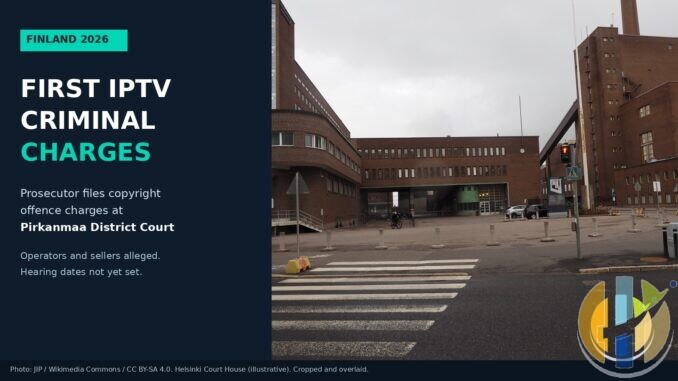
Finland just crossed a line its neighbours crossed years ago. On 6 November 2026 the Finnish Prosecution Service confirmed copyright-offence charges against two people over alleged online IPTV and credential-selling activity, with the charge application already sitting at Pirkanmaa District Court. If you sell “all the channels for less than Netflix” for a living, this is the kind of headline that ruins your weekend. If you only watch TV, it is still a useful map of who prosecutors actually chase.
Quick answer: Finland’s prosecutor has filed copyright-offence charges against two people for alleged online offences spanning 2021–2025 and 2023–2025. One alleged track covers buying viewing and listening credentials from an illegal service and selling them on, plus selling viewing rights from content packages bought for their own use. The other covers setting up and running an illegal IPTV service that offered films and TV channels for payment without rights holders’ permission. The case is at Pirkanmaa District Court (Pirkanmaan käräjäoikeus). Hearing dates are not set yet. Viewers are not named as the defendants in this filing; the charges target the alleged operators and sellers.
What happened, in plain English
On 6 November 2026 the Finnish Prosecution Service (Syyttäjälaitos) published a short notice: the prosecutor has raised copyright-offence charges for acts done on the internet. There are two alleged offences and two suspects. The office says the suspects cooperated during the pre-trial investigation, which is Finnish for “they talked to investigators” rather than a finding of guilt. Nobody has been convicted yet. Charges are accusations that a court still has to test.
The charge application was delivered to Pirkanmaa District Court on 4 November 2026. The prosecutor’s case number is R SY/2026/108200; the court’s case number is R 758/2026/11314. The notice is clear that hearing dates will be agreed later, and that the charge application becomes public once the matter has been before the court, unless the court orders otherwise. Special Prosecutor Erikoissyyttäjä Kukka-Maaria Kankaala is the named contact.
TTVK, Finland’s Copyright Information and Anti-Piracy Centre, put out its own statement the same day and called this the first illegal IPTV service in Finland to face a criminal process. Sweden, it notes, already has criminal judgments against more than ten illegal service operators. That “first in Finland” claim is TTVK’s framing, not a sentence from the prosecutor’s bulletin, and I am labelling it that way on purpose.
One date niggle worth flagging: TTVK’s Finnish text says charges were raised on Wednesday 4.10.2026, while the prosecutor’s own notice says the charge application reached the court on 4.11.2026. I am sticking with the prosecutor’s dates. Treat TTVK’s 4.10 figure as a possible typo until someone publishes a correction; I am not inventing a neat explanation.
What “illegal IPTV” means here
IPTV just means television delivered over the internet. The legal kind is boring in the best way: you pay a licensed broadcaster or platform, they pay the rights holders, and your empty player or smart TV app shows what you are allowed to watch. The illegal kind is the opposite sales pitch: a private seller or “panel” promises live channels, films and sport without a deal with the people who own that content, usually for a monthly fee that would make a legitimate sports package blush.
In this Finnish case the prosecutor describes two related alleged business models:
- Credential and package resale: obtaining viewing and listening credentials from an illegal service and selling them to customers without rights holders’ permission, and also selling viewing rights from content packages acquired for the sellers’ own use.
- Running an illegal IPTV service: setting up and maintaining a service that offered customers numerous films and television channels for payment, again without rights holders’ permission, allegedly for financial gain.
That is the operator and reseller side of the table. It is not a how-to, and I am not naming any pirate brand, panel or playlist. The hardware you own (a Google TV box, a Fire Stick, a phone) is not on trial. What people point that hardware at is the part prosecutors care about when someone is selling access for money.
Operators and sellers versus viewers
Read the prosecutor’s notice carefully and you will notice who is missing: ordinary household viewers are not the defendants in this charge application. The alleged acts are commercial: obtaining credentials, selling them, building a paid IPTV service, doing it for financial gain. TTVK, representing broadcasting companies and Finnish production companies as complainants, still warns that using such a service can amount to copyright infringement under Finnish rules. English-language coverage via Daily Northern, drawing on Yle, quoted copyright lawyer Herkko Hietanen saying watching such services is not currently a criminal offence in Finland, while noting that lawmakers have discussed changing that. Those are two different legal layers (civil infringement versus criminal charge), and neither turns this article into legal advice for your sofa. If you live in Finland and need certainty, talk to a Finnish lawyer or stick to the legal services list at laillisetpalvelut.fi.
TTVK also cites Mediavision AB research from March 2026 claiming illegal IPTV is in about 126,000 Finnish households, with Finns transferring over €36 million a year to those networks. That is industry research via TTVK, not a finding in the Pirkanmaa charge sheet. Useful context, not a conviction rate.
Why this matters outside Finland
Nordic enforcement has been louder in Sweden for longer. TTVK’s comparison is deliberate: Finland is catching up on the criminal track for IPTV operators, while rights holders across Europe keep pushing raids, civil claims and criminal files. For a worldwide reader the pattern looks familiar. Thailand’s DSI action against a Premier League pirate brand made the same point from another continent in my BaygonHero raid write-up. The United States still has the high-profile rebuild story of Omi In A Hellcat after a huge pirate IPTV sentence, which I tracked in the September rebuild piece. Reseller panic after server seizures is not new either; the commercial target stays the same wherever the raid happens.
And the enforcement wave is not only European. On 4 November 2026, Delhi Police raided addresses in Bahadurgarh (Haryana) and Rajouri Garden (Delhi) and arrested an alleged Maya IPTV reseller, according to Economic Times reporting on 6 November 2026. Same week, different continent, same commercial target: people selling unlicensed access, not a tutorial on how to watch it. I have since written up the full Delhi case, including why the app stopped and what Maya viewers should do now, in Maya IPTV not working? Delhi Police arrest alleged reseller.
What to watch next
Update (7 November 2026): the charge application is at Pirkanmaa District Court; hearing dates have not been published. Helsinki sits in Eastern European Time (EET, UTC+2 in winter), so when dates do appear they will be local Finnish court times, not Europe/London clocks. I will not invent a hearing day. Watch for: (1) when the charge application becomes public after the matter is before the court, (2) the first listed hearing date, and (3) whether TTVK or the prosecutor corrects the 4.10 versus 4.11 date mismatch. Until a judgment lands, “charged” does not mean “guilty”.
Legal ways to watch, without the pirate sales pitch
If you are in Finland, start with licensed culture and entertainment services listed at laillisetpalvelut.fi, which TTVK itself points to. Worldwide, the boring answer is still the right one: use an empty player with sources you are allowed to use, or subscribe to platforms that actually license the channels and films. My plain-English map is in IPTV explained 2026, and the platform-by-platform empty-player list is in Best Empty IPTV Players 2026. Empty means the app does not bring channels; you still need a lawful source. UK readers: a TV Licence is about live BBC and related UK rules, not a free pass for an unlicensed “all sport” panel.
Privacy while you read court news on public Wi-Fi
Reading prosecution notices and rights-holder statements on hotel or café Wi-Fi is ordinary research, not a crime. Encrypting that traffic is still sensible, because public networks are nosy and badly run. A VPN does not make an unlicensed stream legal, does not hide you from a Finnish criminal investigation if you are the one selling credentials, and is not a substitute for a licensed subscription. For everyday privacy on shared Wi-Fi I point people to NordVPN, Surfshark, IPVanish, CyberGhost, PureVPN and Ivacy, plus NordPass if your password situation is held together with hope and a sticky note.
Sources for this piece (read 7 November 2026): Finnish Prosecution Service, “Syytteitä nostettu tekijänoikeusrikoksista” (6 November 2026); TTVK, charges statement (6 November 2026); Daily Northern English summary of the same case (6 November 2026); Economic Times on the Delhi Maya IPTV reseller arrest after 4 November 2026 raids (6 November 2026). Images: Helsinki Court House exterior and Helsinki District Court interior by JIP via Wikimedia Commons (CC BY-SA 4.0), used as illustrative Finnish court architecture, not photos of the Pirkanmaa hearing room.
If you want a living-room box that runs licensed apps and empty players properly, these are the ones I keep pointing people to. None of them come with channels, and none of them turn a pirate panel into a legal service.
Best IPTV boxes to buy
These are media boxes and sticks that can run players and licensed apps. The first six are Google certified Android TV or Google TV devices with Google Play. The three Fire TV Sticks run Amazon’s own systems with the Appstore instead of Google Play: the 4K Max and 4K Plus run Fire OS, which is Android based, while the new Fire TV Stick 4K (2026) runs Vega OS, which does not allow sideloading Android apps, only Appstore apps. The last one, the Formuler, runs its own Android and is not certified. They are not pirate hardware. They do not come with channels or playlists. I am not claiming I personally lab-tested every SKU this month.
Pick a Google TV box when you want Play Store apps on a proper TV OS or a dedicated player behind the sofa. Pick a Fire TV Stick when Prime Video and the Appstore already cover what you watch. If you need an Android player from outside the Appstore, skip the Vega OS stick.
- NVIDIA SHIELD TV Pro: the premium pick, a certified Android TV player with AI upscaling, Dolby Vision/Atmos and Gigabit Ethernet for the main living-room telly. Amazon UK | Amazon US | Amazon DE | Amazon FR | Amazon IT
- Google TV Streamer 4K: solid Google TV living-room default with Ethernet, 32GB storage and Dolby Vision/Atmos. Amazon UK | Amazon US | Amazon DE | Amazon FR | Amazon IT
- Xiaomi TV Box S (3rd Gen): Google TV box with 32GB storage, Wi-Fi 6 and Dolby Vision/Atmos, the cheaper box route than the Streamer. Amazon UK | Amazon US | Amazon DE | Amazon FR | Amazon IT
- Xiaomi TV Stick 4K (2nd Gen): budget Google TV stick with Wi-Fi 6 and Dolby Vision/Atmos when you want HDMI-simple, not a full box. Amazon UK | Amazon US | Amazon DE | Amazon FR | Amazon IT
- Budget Google TV 4K player: a cheaper certified Google TV player for a second telly. The model differs by store, so each link names the one you get there. MECOOL KD3 (Amazon UK) | onn. Google TV 4K Streaming Box (Amazon US) | Strong LEAP-NOVA-X (Amazon DE) | Strong LEAP-NOVA-X (Amazon FR) | Strong LEAP-NOVA-X (Amazon IT)
- MECOOL MEon1: Google TV certified 4K box with AI upscaling and 32GB storage for a dedicated player behind the sofa. Amazon UK
- Fire TV Stick 4K Max: the most powerful Fire TV Stick, with Wi-Fi 6E, Dolby Vision/Atmos and 16GB storage. It runs Fire OS, which is Android based, so you get Appstore apps and can still sideload an Android player. Amazon UK | Amazon US | Amazon DE
- Fire TV Stick 4K Plus: the older Fire OS stick with Wi-Fi 6 and Dolby Vision/Atmos. It is being phased out, so buy it only while stock lasts. Like the Max, it can still sideload Android apps. Amazon UK | Amazon US | Amazon DE | Amazon FR | Amazon IT
- Fire TV Stick 4K (2026): the newest and slimmest 4K stick, with a new remote. It runs Vega OS, which does not allow sideloading Android apps, only Appstore apps, so check your player is in the Appstore before you buy. Amazon UK | Amazon US | Amazon DE | Amazon FR | Amazon IT
- Formuler Z12 Ultra SE: the newest Formuler box, built around MYTVOnline 4 for IPTV playlists. It runs Formuler’s own Android rather than certified Google TV, so there is no Netflix in HD and no Google certification. Formuler Z12 Ultra SE (Amazon UK) | Formuler Z12 Ultra SE (Amazon US) | Formuler Z12 Ultra SE (Amazon DE) | Formuler Z12 Ultra SE (Amazon FR) | Formuler Z12 Ultra SE (Amazon IT)
Whichever you pick, check that the app you need is in its store before you pay. And none of these boxes or sticks magically make unlicensed streams legal.
Should Finland’s first illegal IPTV criminal case change how other countries treat resellers, or is this just Sweden’s neighbour finally joining the queue? Tell me in the comments.
Written by Dr Husham Memar