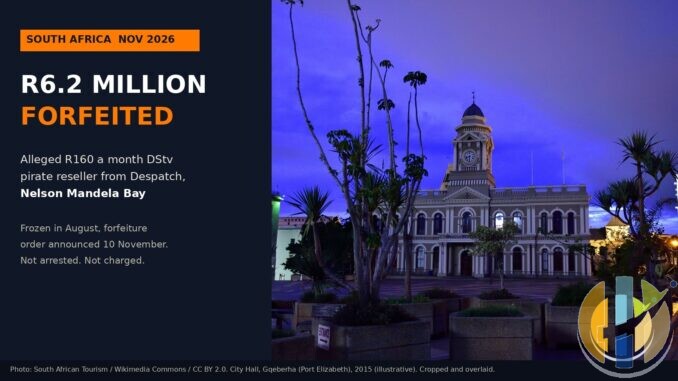
If you have ever been offered “all of DStv for R160 a month” in a WhatsApp chat, this week’s news from South Africa’s Eastern Cape is about where that kind of money can end up. The High Court in Gqeberha has ordered about R6.2 million in a bank account belonging to Damian Grundlingh, of the small town of Despatch in Nelson Mandela Bay, to be forfeited to the state over an alleged pirate DStv streaming service.
He has not been arrested or charged, and the money has still gone. That combination is why this case matters today, wherever you watch TV.
Quick answer
- What happened: the Eastern Cape Division of the High Court in Gqeberha granted the National Prosecuting Authority’s Asset Forfeiture Unit (AFU) a forfeiture order for about R6.2 million held in an FNB account belonging to Damian Grundlingh. The NPA announced it on Tuesday 10 November 2026. It follows a preservation order, the freeze, obtained on 4 August.
- The allegation: an illegal live streaming service running since at least October 2024, selling access codes to MultiChoice content for about R160 a month, with roughly 104,667 MultiChoice related transactions between January 2025 and April 2026.
- Is he guilty? Nobody has said so. He has not been arrested or charged, and the criminal investigation under the Cybercrimes Act and the Copyright Act is ongoing. The forfeiture is a civil process aimed at the money.
- Are viewers at risk? Nothing I read mentions action against customers. The practical risks are a service that vanishes overnight and personal details sitting with an unlicensed seller.
What happened, and where
Despatch is a town of about 40,000 people, according to MyBroadband, just outside Gqeberha (the city formerly known as Port Elizabeth) in the Nelson Mandela Bay metro. NPA spokesperson Luxolo Tyali said evidence put to the court alleged that Grundlingh “operated an illegal live streaming service from at least October 2024 by unlawfully accessing and distributing copyrighted MultiChoice content without authorisation”. Customers allegedly paid around R160 a month for access codes.
The case came out of joint work by the NPA’s Specialised Commercial Crime Unit, the Hawks, the Financial Intelligence Centre and investigators from MultiChoice itself. How the content was obtained or distributed is still unknown, says MyBroadband.
Eastern Cape Director of Public Prosecutions Samkelo Mtwana said the forfeiture “demonstrates that the NPA will not only pursue those suspected of engaging in unlawful activities but will also target the proceeds generated from such conduct.” Translation from prosecutor to plain English: we may not have charged anyone yet, but we have the bank balance.
Frozen or forfeited? Why the headlines disagree
On Thursday 12 November, veteran TV journalist Thinus Ferreira reported that Grundlingh had R6.2 million “frozen” by the court, and MyBroadband, citing him, said it happened “on Thursday”. The same day, News24 ran the headline “Court orders MultiChoice streaming ‘pirate’ to forfeit more than R6m”. Both cannot be the latest step, so I went back to the NPA’s own statements, as reported by TimesLive and NovaNews on 10 November and IOL in August.
The sequence is this. On 4 August 2026 the AFU obtained a preservation order: the money was frozen, without prior notice to Grundlingh, which the Prevention of Organised Crime Act (POCA) allows even when no charges exist. The order was then served on him and, the NPA says, not opposed. Under POCA, if a preservation order is not opposed, the prosecuting authority can apply for a forfeiture order within 90 days of the preservation order being published in the Government Gazette. That is what has now been granted, under section 48 of POCA. According to the NPA, forfeited funds are paid into the Criminal Assets Recovery Account, which supports law enforcement work.
So “frozen” is true of August and “forfeited” is true of November. The NPA statements I read do not give the exact day the judge signed the forfeiture order, only that it was announced on Tuesday 10 November (South Africa runs two hours ahead of the UK at this time of year). Headlines, like pirate streams on a big match night, sometimes buffer.
Forfeiture without a conviction: what that means
“POCA provides for non-conviction-based asset forfeiture proceedings,” Tyali said, letting prosecutors go after property alleged to be the proceeds of unlawful activities “independently of criminal prosecution and conviction.” The case is against the money, not the man. Until a criminal court says otherwise, every allegation in this story stays an allegation.
It is a very different route from the one the UK took with the Chorley man jailed for six and a half years over a £1m illegal IPTV operation, where the criminal trial came first. South Africa’s message: you can lose the profits long before anyone reads you your rights.
Are viewers at risk?
Nothing in the NPA statements mentions customers, and I am not going to invent a crackdown on subscribers for dramatic effect. The more useful lesson is what happened in Cape Town in April. MultiChoice told MyBroadband that its content protection arm, Irdeto, got into the panel a pirate provider used to run its accounts and deactivated 819 of them; 715 users lost access, the main reseller was arrested, and two cellphones were seized for forensic examination.
From the customer’s side: the service can be switched off from the inside, the money paid upfront goes with it, and your phone number may sit on a handset in an evidence bag. It is the same pattern I described in the Netherlands, where Brein says about 200 reseller sites went offline this year, and in India after the Maya IPTV reseller arrest in Delhi.
How to spot a pirate reseller
- The price is a fantasy. R160 a month for what is presented as DStv is well below what MultiChoice charges for its own streaming packages (see below). Nobody is that generous with Premier League rights.
- It is sold in chats and comment sections. MyBroadband notes pirate services in South Africa often advertise through resellers on Facebook and WhatsApp, with websites taken down and quickly replaced.
- You get an “access code” from a person rather than an account with a licensed company and a proper invoice.
- The box arrives already full of channels. Legitimate boxes come empty. Preloaded ones can carry worse than stolen channels, as the XCPE Android TV botnet showed.
- Payment goes to a personal account or upfront for many months. “Lifetime” means the lifetime of the seller’s luck.
Legal ways to watch DStv content in South Africa
The obvious ones are a DStv satellite package or the DStv Stream app, MultiChoice’s standalone streaming service with live channels, SuperSport and on demand content. In its own announcement of 15 April 2026, MultiChoice said DStv Compact Stream “is available from R299”. Prices change, so check the official DStv site.
One update for anyone still looking for the Showmax app: MultiChoice, now part of Canal+, closed Showmax on 30 April 2026 at 23:59. Canal+ called it a retirement “after comprehensive review”, which is corporate for “the spreadsheet won”. Showmax Originals and selected titles moved to a Showmax section inside DStv Stream for DStv Compact and DStv Premium customers.
Update and what to watch next
Update (16 November 2026): as of about 09:35 UK time (11:35 in South Africa), I found no report of Grundlingh being arrested or charged. The latest on the record word is the NPA statement of Tuesday 10 November.
What to watch next:
- Whether the criminal investigation leads to charges under the Cybercrimes Act or the Copyright Act, or quietly does not.
- Whether anyone explains how the content was accessed.
- More non-conviction-based forfeitures in piracy cases, now the AFU has shown the tool works.
Europe had its own reminder this week. On 11 November Modernet Digital reported that the Provincial Court of Madrid gave six executives of a company called GTMAX sentences of one year and eleven months, under plea agreements, for criminal organisation and an intellectual property offence, over 42,530 GTMEDIA decoders sold between 2019 and 2021. The Chinese manufacturer’s owner never turned up in court, which is one way to skip the small print.
How to get a VPN (for privacy, not for piracy)
A VPN is useful for privacy on public Wi-Fi, in hotels and when travelling. It does not make an unlicensed stream legal, and it will not delete your number from a reseller’s phone. With that asterisk firmly attached, these are the services I point people to: NordVPN, Surfshark (with guides for Fire TV and IPTV players), IPVanish, CyberGhost, PureVPN and Ivacy. And if your DStv password is also your banking password, NordPass will do more for you than any streaming box.
Sources for this piece (read 14 November 2026): TimesLive, “AFU wins R6.2m forfeiture order in alleged MultiChoice piracy case” (10 November 2026); NovaNews, “Court grants R6.2 million forfeiture order in alleged piracy case” (10 November 2026); IOL, “Court freezes R6.2 million in massive MultiChoice piracy bust” (August 2026); Thinus Ferreira, TV with Thinus (12 November 2026); MyBroadband, “Man who sold DStv for R160 has R6.2 million frozen by court” (November 2026); News24 headline, 12 November 2026; DStv, “Showmax Originals have a new home on DStv Stream” (15 April 2026) and Showmax closure FAQ; Modernet Digital, “42,530 decoders and nearly two years in prison for hacking Netflix” (11 November 2026). Images: City Hall, Gqeberha by South African Tourism and Nelson Mandela Bay Stadium by Ngrund, both CC BY 2.0 via Wikimedia Commons, used as illustrative location photos.
If you want a box for the DStv Stream app, Netflix and proper empty players, these are the ones I keep recommending. None of them come with channels, and none of them turn an R160 access code into a licence.
Best IPTV boxes to buy
These are media boxes and sticks that can run players and licensed apps. The first six are Google certified Android TV or Google TV devices with Google Play. The three Fire TV Sticks run Amazon’s own systems with the Appstore instead of Google Play: the 4K Max and 4K Plus run Fire OS, which is Android based, while the new Fire TV Stick 4K (2026) runs Vega OS, which does not allow sideloading Android apps, only Appstore apps. The last one, the Formuler, runs its own Android and is not certified. They are not pirate hardware. They do not come with channels or playlists. I am not claiming I personally lab-tested every SKU this month.
Pick a Google TV box when you want Play Store apps on a proper TV OS or a dedicated player behind the sofa. Pick a Fire TV Stick when Prime Video and the Appstore already cover what you watch. If you need an Android player from outside the Appstore, skip the Vega OS stick.
- NVIDIA SHIELD TV Pro: the premium pick, a certified Android TV player with AI upscaling, Dolby Vision/Atmos and Gigabit Ethernet for the main living-room telly. Amazon UK | Amazon US | Amazon DE | Amazon FR | Amazon IT
- Google TV Streamer 4K: solid Google TV living-room default with Ethernet, 32GB storage and Dolby Vision/Atmos. Amazon UK | Amazon US | Amazon DE | Amazon FR | Amazon IT
- Xiaomi TV Box S (3rd Gen): Google TV box with 32GB storage, Wi-Fi 6 and Dolby Vision/Atmos, the cheaper box route than the Streamer. Amazon UK | Amazon US | Amazon DE | Amazon FR | Amazon IT
- Xiaomi TV Stick 4K (2nd Gen): budget Google TV stick with Wi-Fi 6 and Dolby Vision/Atmos when you want HDMI-simple, not a full box. Amazon UK | Amazon US | Amazon DE | Amazon FR | Amazon IT
- Budget Google TV 4K player: a cheaper certified Google TV player for a second telly. The model differs by store, so each link names the one you get there. MECOOL KD3 (Amazon UK) | onn. Google TV 4K Streaming Box (Amazon US) | Strong LEAP-NOVA-X (Amazon DE) | Strong LEAP-NOVA-X (Amazon FR) | Strong LEAP-NOVA-X (Amazon IT)
- MECOOL MEon1: Google TV certified 4K box with AI upscaling and 32GB storage for a dedicated player behind the sofa. Amazon UK
- Fire TV Stick 4K Max: the most powerful Fire TV Stick, with Wi-Fi 6E, Dolby Vision/Atmos and 16GB storage. It runs Fire OS, which is Android based, so you get Appstore apps and can still sideload an Android player. Amazon UK | Amazon US | Amazon DE
- Fire TV Stick 4K Plus: the older Fire OS stick with Wi-Fi 6 and Dolby Vision/Atmos. It is being phased out, so buy it only while stock lasts. Like the Max, it can still sideload Android apps. Amazon UK | Amazon US | Amazon DE | Amazon FR | Amazon IT
- Fire TV Stick 4K (2026): the newest and slimmest 4K stick, with a new remote. It runs Vega OS, which does not allow sideloading Android apps, only Appstore apps, so check your player is in the Appstore before you buy. Amazon UK | Amazon US | Amazon DE | Amazon FR | Amazon IT
- Formuler Z12 Ultra SE: the newest Formuler box, built around MYTVOnline 4 for IPTV playlists. It runs Formuler’s own Android rather than certified Google TV, so there is no Netflix in HD and no Google certification. Formuler Z12 Ultra SE (Amazon UK) | Formuler Z12 Ultra SE (Amazon US) | Formuler Z12 Ultra SE (Amazon DE) | Formuler Z12 Ultra SE (Amazon FR) | Formuler Z12 Ultra SE (Amazon IT)
Whichever you pick, check that the app you need is in its store before you pay. And none of these boxes or sticks magically make unlicensed streams legal.
Should prosecutors be allowed to take the money before anyone is charged, or is that exactly the shortcut piracy cases need? Tell me in the comments.
Written by Dr Husham Memar