
Cloudflare has suffered a setback in the piracy liability case filed against it by adult publisher ALS Scan. A federal court in California ruled that the CDN provider can substantially assist copyright infringements by hosting cached copies of files. Whether Cloudflare did this and if it's indeed liable, is now a matter for a jury to decide.
 As one of the leading CDN and DDoS protection services, Cloudflare is used by millions of websites across the globe.
This includes thousands of “pirate†sites, including the likes of The Pirate Bay, which rely on the U.S.-based company to keep server loads down.
Many rightsholders have complained about Cloudflare’s involvement with these sites and in 2016 adult entertainment publisher ALS Scan took it a step further by dragging the company to court.
ALS accused the CDN service of various types of copyright infringement, noting that several customers used Cloudflare’s servers to distribute pirated content. While Cloudflare managed to have several counts dismissed, the accusation of contributory copyright infringement remains.
With the case heading to trial, both sides have submitted motions for partial summary judgment on this contributory infringement claim. This week California District Court Judge George Wu ruled on the matter, denying the CDN provider’s motion in its entirety.
One of Cloudflare’s arguments was that it did not substantially assist copyright infringements because the sites would remain online even if they were terminated from the service. It can’t end the infringements entirely on its own, the company argued.
The Court disagreed with this assessment, noting that Cloudflare’s cache can be seen as a substantial infringement by itself, which is something the company has control over.
“First of all, as to the infringements that are the cache copies, Cloudflare does appear to have the master switch,†Judge Wu writes.
“Second of all, just because the infringing images will remain online, does not mean the assistance is insubstantial. If that were true, then liability based on server space would rely on whether or not an infringing site had, or could acquire a backup server.â€
Cloudflare also stressed that there are no simple measures it could take in response to alleged copyright infringements. Removing a cached copy based on a takedown notice is not an option, the company argued, as that leaves sites and their users vulnerable to malicious attacks.
Judge Wu didn’t deny that terminating service to sites such as ‘bestofsexpics.com and cumonmy.com’ could cause security issues but added that this doesn’t mean that it’s okay for Cloudflare to support illegal activity.
“[I]f Cloudflare’s logic were accepted, there would be no web content too illegal, or dangerous, to justify termination of its services. While Cloudflare may do amazing things for internet security, the Court would have a hard time accepting that Cloudflare’s security features give it license to assist in any online activity,†Judge Wu writes.
From the order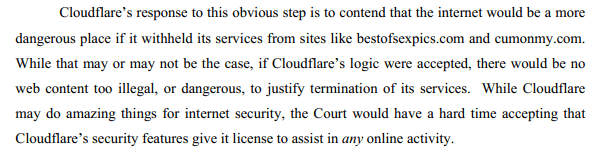
Moving on to ALS’ motion, which was also denied in part, the Court brings more bad news for Cloudflare. While the CDN provider keeps its safe harbor defense at trial, the Court ruled that the existence of cache copies can be sufficient to prove that Cloudflare assisted in the alleged copyright infringements.
“The Court would find that, as a legal matter, Cloudflare’s CDN Network, to the extent it is shown to have created, stored, and delivered cache copies of infringing images, substantially assisted in infringement,†the order reads.
“The reason is straightforward: without Cloudflare’s services those cache copies would not have been created and served to end users,’ a footnote clarifies.
The order doesn’t draw any conclusions about actual infringements. However, if ALS can prove to the jury that specific images were in Cloudflare’s cache, without permission, the “substantial assistance†element required for contributory liability is established.
If that happens, the only remaining element at trial is whether Cloudflare was aware of these infringements, which is where the takedown notices would come in.
The case will soon be in the hands of the jury and can still go in either direction. However, the order puts Cloudflare at a disadvantage as it can no longer argue that cached copies of infringing content by themselves are non-infringing. This will obviously be a concerns to other CDN providers as well, which makes this a landmark case.
—
A copy of Judge Wu’s ruling, obtained by TorrentFreak, is available here (pdf).
Written by David Minister
Source link