Amazon did it with a sledgehammer. Its new Vega OS Fire TV Sticks simply refuse to install anything that is not in the Amazon Appstore. Google is doing something gentler, slower and much better dressed, but the direction of travel looks familiar. Since 30 September 2026, Android has started checking who made an app before it lets you install it, and from 2027 that check is meant to go global.
“Quietly” is perhaps unfair. Google announced it on a blog, rewrote the plan more than once, published a FAQ the length of a mortgage contract and got an open letter signed by the EFF for its trouble. But most people with an Android phone or a Google TV box have still never heard of it. So here is what is actually confirmed, what it means for TV boxes, APKs and F-Droid, and how it compares with Amazon’s locked door.
What Google actually announced
The idea first appeared on 25 August 2025 in a post called A new layer of security for certified Android devices. Google said Android would “require all apps to be registered by verified developers in order to be installed by users on certified Android devices”, including apps from outside Google Play. It compared this to an ID check at the airport: Google confirms who the developer is, not what is in the app.
The reason given is malware. In August 2025 Google said it had found over 50 times more malware from internet sideloaded sources than on Google Play. By its March 2026 update, that figure had become “over 90 times”. Either sideloading got much nastier in seven months, or the statistics department has been to the gym.
Developers verify their identity in the new Android Developer Console, or in Play Console if they already publish there, and register each app’s package name and signing key. A full distribution account costs $25 and needs ID, according to the official FAQ.
The dates, as of today
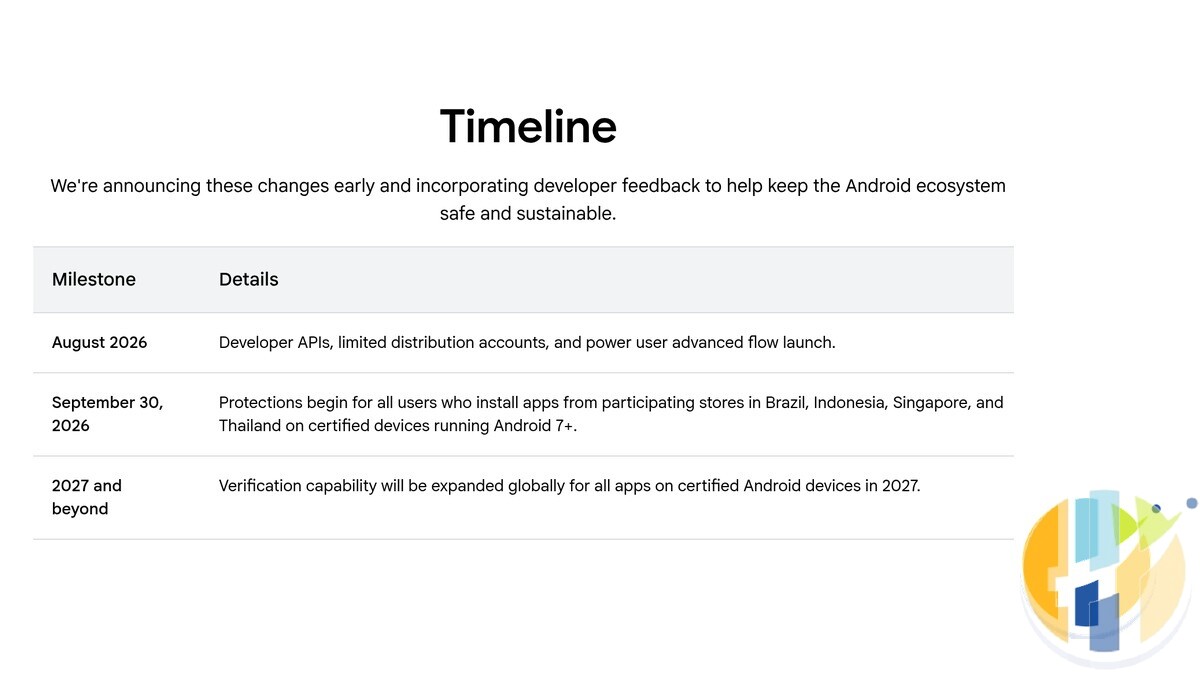
The timeline has moved more than a Premier League fixture list. This is where Google’s own pages stand on 11 October 2026:
- November 2025: developers in early access were invited to verify apps they distribute outside Play.
- March 2026: verification opened to all developers in the Android Developer Console and Play Console.
- June 2026: Google began rolling out a new system service to most Android devices, which will be used to check registrations.
- August 2026: limited distribution accounts and the “advanced flow” for power users launched.
- 30 September 2026: enforcement began in Brazil, Indonesia, Singapore and Thailand on certified devices running Android 7 or later.
- 2027: Google says verification “will be expanded globally for all apps on certified Android devices”. No exact date yet.
Here is the important small print. In its June 2026 update, Google narrowed the first phase to installs from seven participating stores: Google Play, Samsung Galaxy Store, Xiaomi GetApps, OPPO App Market, HONOR App Market, vivo V-Appstore and Transsion’s Palm Store. The FAQ says that if users sideload an app directly or use another store, the new requirements “won’t apply to your app yet”. It also says that, outside Google Play, enforcement in this phase applies only to phones and tablets. The Verge and Android Authority confirmed the rules went live on schedule. If you live in the UK, US or Europe, nothing has changed on your devices yet.
The escape hatches
Google has kept three routes for people who do not want, or cannot get, verified:
- ADB. Installing over Android Debug Bridge from a computer does not require registration. Google says “there are no changes to how ADB works”.
- Limited distribution accounts. For students, hobbyists and teachers. No government ID, no fee, but apps can only go to up to 20 devices.
- The advanced flow. A one-time setup that lets you install apps from unverified developers. You turn on developer mode, confirm nobody is coaching you, restart and reauthenticate, then wait 24 hours before confirming with your fingerprint, face or PIN. After that you can allow unverified installs for seven days or indefinitely, tapping “Install Anyway” past a warning each time.
The 24-hour wait is aimed at scam calls, where a fraudster talks a victim into installing a fake banking app on the spot. That is a real problem, and a day’s cooling off is a clever answer to it. It is also the most Google thing imaginable: freedom, available tomorrow, after a reboot and a short quiz.
One catch the FAQ spells out: if you switch the advanced flow off again, updates to unregistered apps fail until you switch it back on or use ADB.
What it means for Google TV and Android TV boxes
Certified Google TV and Android TV devices are certified Android devices, so the 2027 global rollout is aimed at them too. For now, Google’s FAQ limits off-Play enforcement to phones and tablets, and recommends developers register apps for all form factors “to future-proof” them.
What Google has not done is explain how the advanced flow will feel on a television. The published steps talk about restarting “your phone” and using fingerprint or face unlock. A Google TV Streamer has neither a fingerprint reader nor a face. Until Google publishes TV-specific steps, assume the TV version will lean on a PIN and on ADB, which TV power users already know well.
For ordinary viewers who install apps from Google Play, the change should be invisible, because Google says over 99% of Play apps have already been registered. Legal player apps from established developers will almost certainly be verified. The people who will feel it are fans of small open source tools, unofficial launchers and homemade utilities whose developers would rather not post their passport to Mountain View.
F-Droid is not amused
F-Droid, the long-running catalogue of free and open source Android apps, has opposed the plan from the start. In September 2025 it warned that the registration requirement “will end the F-Droid project and other free/open-source app distribution sources as we know them today”, partly because F-Droid cannot register other people’s apps on their behalf without effectively claiming them. In February 2026 it signed an open letter opposing developer verification, and in July it called the new verifier service a “trojan horse”, saying over 70 organisations including the EFF and FSF had signed against it.
Google’s answer is that sideloading “is fundamental to Android, and it’s not going anywhere”, in the words of its Developer Console help page. Both can be true at once: sideloading survives, with more paperwork, more waiting and Google deciding who counts as verified.
Amazon went further, faster
Amazon skipped the paperwork. Its Vega OS is not Android at all, and Amazon’s developer site says that starting with the Fire TV Stick 4K Select, all future Fire TV Sticks will run on Vega, as Ars Technica reported. The retail listings say the device “prevents sideloading or installing apps from unknown sources”. No advanced flow, no 24-hour wait, no ADB loophole for normal households. The new Fire TV Stick 4K announced on 30 September 2026 runs Vega 2.0 and follows the same rule.
I have covered this in detail: what stops working on the new Vega Fire TV Stick 4K, and how to tell Vega from Android-based Fire OS before you pay.
So is Google following Amazon? On direction, yes. Both companies now say open installs are a security risk and both want a name attached to every app. On method, not yet. Amazon closed the door. Google installed a doorman who checks ID, lets regulars in and makes everyone else wait a day. The question for 2027 is whether the doorman stays polite.
If you buy a streaming box, the practical advice has not changed: pick a certified device, get your apps from official stores where you can, and remember that a player app is only a player. It needs a service you are licensed to watch or media you own.
Best IPTV boxes to buy
These are media boxes and sticks that can run players and licensed apps. The first six are Google certified Android TV or Google TV devices with Google Play; the last one, the Formuler, runs its own Android and is not certified. They are not pirate hardware. They do not come with channels or playlists. I am not claiming I personally lab-tested every SKU this month.
Buy one of these when: Fire TV sideload is a hassle on your model, you want Play Store apps on a proper TV OS, or you want a dedicated player shell behind the sofa. No Fire TV device is on this shortlist.
- NVIDIA SHIELD TV Pro: the premium pick, a certified Android TV player with AI upscaling, Dolby Vision/Atmos and Gigabit Ethernet for the main living-room telly. Amazon UK | Amazon US | Amazon DE | Amazon FR | Amazon IT
- Google TV Streamer 4K: solid Google TV living-room default with Ethernet, 32GB storage and Dolby Vision/Atmos. Amazon UK | Amazon US | Amazon DE | Amazon FR | Amazon IT
- Xiaomi TV Box S (3rd Gen): Google TV box with 32GB storage, Wi-Fi 6 and Dolby Vision/Atmos, the cheaper box route than the Streamer. Amazon UK | Amazon US | Amazon DE | Amazon FR | Amazon IT
- Xiaomi TV Stick 4K (2nd Gen): budget Google TV stick with Wi-Fi 6 and Dolby Vision/Atmos when you want HDMI-simple, not a full box. Amazon UK | Amazon US | Amazon DE | Amazon FR | Amazon IT
- Budget Google TV 4K player: a cheaper certified Google TV player for a second telly. The model differs by store, so each link names the one you get there. MECOOL KD3 (Amazon UK) | onn. Google TV 4K Streaming Box (Amazon US) | Strong LEAP-NOVA-X (Amazon DE) | Strong LEAP-NOVA-X (Amazon FR) | Strong LEAP-NOVA-X (Amazon IT)
- MECOOL MEon1: Google TV certified 4K box with AI upscaling and 32GB storage for a dedicated player behind the sofa. Amazon UK
- Formuler Z12 Ultra SE: the newest Formuler box, built around MYTVOnline 4 for IPTV playlists. It runs Formuler’s own Android rather than certified Google TV, so there is no Netflix in HD and it is the one box here without Google certification. Formuler Z12 Ultra SE (Amazon UK) | Formuler Z12 Ultra SE (Amazon US) | Formuler Z12 Ultra SE (Amazon DE) | Formuler Z12 Ultra SE (Amazon FR) | Formuler Z12 Ultra SE (Amazon IT)
Still shopping for a Fire TV device? Fine for Prime Video and the Appstore universe. Not the shortlist above. And none of these boxes magically make unlicensed streams legal.
Sources
- Android Developers Blog: A new layer of security for certified Android devices (25 August 2025)
- Android Developers Blog: Android developer verification, rolling out to all developers (March 2026, clarified 29 September 2026)
- Android Developers Blog: Android developer verification, building a safer ecosystem together (18 June 2026)
- Android Developers: Android developer verification (timeline)
- Android Developers: Android developer verification FAQ (last updated 30 September 2026)
- Android Developer Console Help: Understanding Android developer verification
- The Verge: Android’s developer verification rules just took effect for the first time (2 October 2026)
- Android Authority: Android’s controversial new sideloading rules are officially here
- F-Droid: F-Droid and Google’s Developer Registration Decree (29 September 2025)
- F-Droid: An Open Letter Opposing Android Developer Verification (24 February 2026)
- F-Droid: What We Talk About When We Talk About Malware (1 July 2026)
- Ars Technica: Amazon won’t release Fire Sticks that support sideloading anymore (17 April 2026)
- Amazon: Faster, slimmer 4K streaming stick, new remote and Vega 2.0 (30 September 2026)
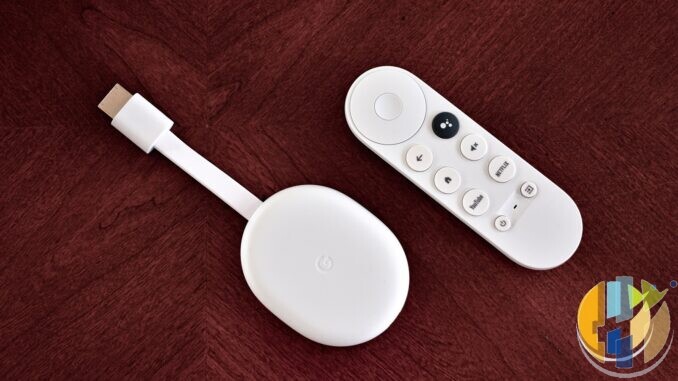
Featured photo: “Chromecast-with-Google-TV-snow-color-on-wood-table2” by Y2kcrazyjoker4, Wikimedia Commons, CC BY-SA 4.0, cropped and resized. Inline image: screenshot of Google’s Android developer verification timeline at developer.android.com, 11 October 2026.
Written by Dr Husham Memar