
Following comments this week from Japan’s Chief Cabinet Secretary, blocking pirate sites could soon be on the country’s anti-piracy agenda. Yoshihide Suga says that the government is considering “all measures” to reduce piracy of manga and anime while supporting the “Cool Japan” initiative designed to promote the country locally and overseas.
 When attempting to deal with the flood of pirate content on the Internet, companies have many options at their disposal.
One of the most controversial is site-blocking, but despite its unpopularity with consumers, dozens of countries around the world are now involved in the practice. Quite regularly new countries consider getting involved, Canada for example. The latest new addition is Japan.
Speaking at a news conference, Chief Cabinet Secretary Yoshihide Suga said that the Japanese government is considering taking measures to prohibit access to pirate sites, largely to protect the country’s manga and anime industries.
“The damage is getting worse. We are considering the possibilities of all measures including site blocking,†he said.
“Manga and anime are important types of content that represent the ‘Cool Japan’ initiative. I would like to take countermeasures as soon as possible under the cooperation of the relevant ministries and agencies.â€
Cool Japan is a campaign to promote Japan, its culture, products and businesses both at home and overseas, in order to generate interest in the country while boosting investment and tourism.
Outline of the Cool Japan initiative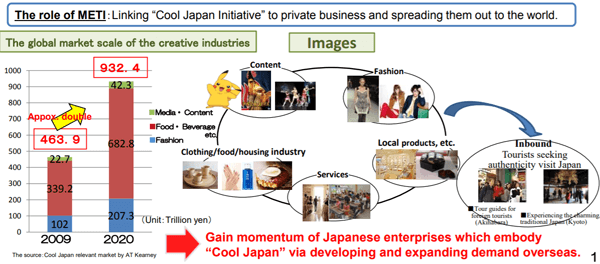
According to a lawyer cited by the Sankei news outlet, piracy in Japan is largely facilitated by roughly two kinds of sites – hosting and linking.
While the former can be anywhere but can be dealt with locally, Japan has an estimated 200 sites that link to pirated content. Their legal status doesn’t appear to be as clear as many would like.
“In the conventional theory the link itself is not illegal,†the lawyer notes. “There is no legal basis to declare the act of facilitating piracy of other sites as ‘illegal’. Without a [linking] site, many users can not reach pirated versions, [so the government] needs to define malicious [linking] sites properly and regulate them.â€
It appears that like many nations, Japan doesn’t view piracy as a predominantly domestic issue, at least on the supply front. In common with the UK, Australia and many other ‘blocking’ nations, it sees the problem as being fueled by overseas actors over which it has limited control. Site-blocking locally, therefore, could stop the problem at the borders.
Whether any plan will be any more effective than the programs elsewhere will remain to be seen but since the Japanese hold both anime and manga close to their hearts, the debate is bound to get emotional.
“As long as the normal business model of content is undermined, the number of people trying to become new professional creators will decrease, and if you are an animator, know-how such as drawing, editing and reviewing may be lost. There is a danger that you will be unable to read interesting cartoons in future, as the biggest victim of piracy is actually the reader himself,†the lawyer concludes.
This past week saw perhaps the single wildest display of copyright infringement ever directed at Japanese culture by those in authority. Local governments across South America defied the Japanese government by airing the latest episode of Dragon Ball Super in public places to tens of thousands of people, all without obtaining the necessary licensing.
Written by David Minister